

Unlock AI Concepts: The Proven Guide to Artificial Intelligence Fundamentals
Artificial intelligence (AI) is no longer a futuristic fantasy—it's woven into the fabric of our daily lives. From the algorithms powering our social media feeds to the virtual assistants in our pockets, understanding the foundational AI concepts is increasingly crucial. Did you know that AI could contribute over $15.7 trillion to the global economy by 2030? This guide will demystify the essential AI concepts, providing you with a clear understanding of this transformative technology.
Navigating the world of artificial intelligence can feel daunting, with terms like machine learning, deep learning, and neural networks often creating confusion. However, grasping these core AI concepts is vital for anyone looking to understand the present and future of technology. This comprehensive guide will break down the key AI concepts in an accessible and engaging manner, whether you're a tech enthusiast, a business professional, or simply curious about the power of artificial intelligence. Let's dive into the fundamental AI concepts that are shaping our world.
- The 5 Big Ideas Shaping Artificial Intelligence
- Understanding the 7 Main Types of AI
- Core Components Powering AI Systems
- Machine Learning and Deep Learning Essentials
- Real-World Applications and Examples
- FAQ Section
The 5 Big Ideas Shaping Artificial Intelligence 🧠

The foundation of modern artificial intelligence rests upon five core AI concepts. These fundamental ideas drive innovation and help us comprehend the broad capabilities of AI systems:
- Perception 👁️: AI's ability to interpret the world through sensors. This includes computer vision for understanding images and natural language processing (NLP) for comprehending human language, allowing AI to interact with its environment.
- Representation and Reasoning 🔄: How AI organizes and uses knowledge to make decisions. This involves structuring data effectively and employing logical algorithms to solve problems and draw conclusions.
- Learning 📚: The capability of AI systems to improve performance through experience using machine learning algorithms. This encompasses supervised, unsupervised, and reinforcement learning.
- Human-AI Interaction 🤝: Designing intuitive interfaces that enable effective collaboration between humans and AI, including advancements in NLP and user experience.
- Societal Impact 🌍: Understanding the ethical, legal, and social implications of AI deployment to ensure responsible development and mitigate potential negative consequences.
Understanding the 7 Main Types of AI 🔍
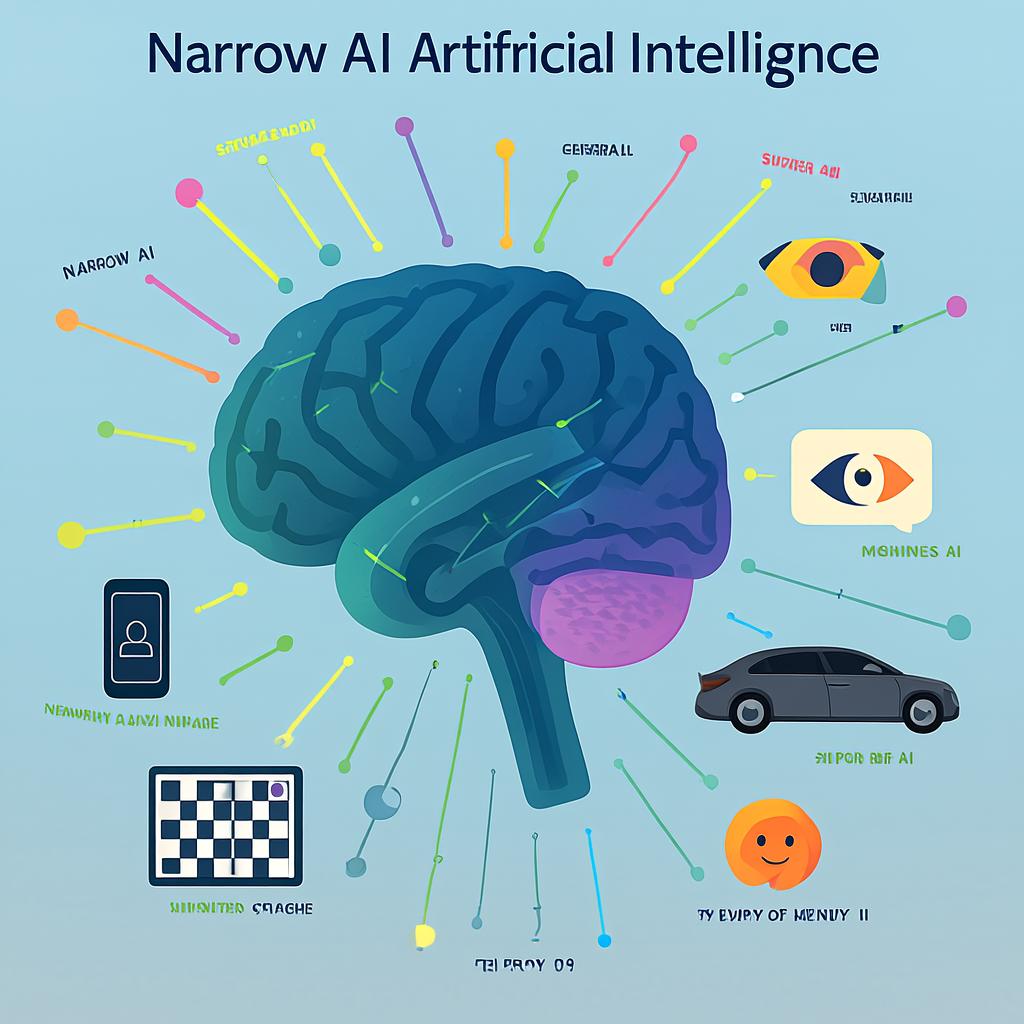
The landscape of artificial intelligence can be categorized into seven main types, each with varying levels of capability and application:
- Narrow AI (Artificial Narrow Intelligence): Excels at specific tasks, like recommendation systems and virtual assistants. This is the most common form of AI today.
- General AI (Artificial General Intelligence): Hypothetical AI with human-level intelligence across all cognitive tasks. Currently does not exist.
- Super AI (Artificial Super Intelligence): Theoretical AI surpassing human intelligence in all aspects. Remains purely speculative.
- Reactive Machines: Basic AI that reacts to current situations without memory, like IBM's Deep Blue.
- Limited Memory AI: Uses past data for decision-making, common in applications like self-driving cars.
- Theory of Mind AI: Theoretical AI that understands emotions and intentions of others. Still in early research stages.
- Self-Aware AI: The most advanced theoretical form, possessing consciousness and self-awareness.
Core Components Powering AI Systems ⚙️
Several key components work in tandem to power artificial intelligence systems effectively:
- Data Processing and Management 📊: The foundation, involving data collection, cleaning, and storage for AI algorithms.
- Algorithms and Models 🔧: The mathematical frameworks, such as neural networks, that enable learning and prediction.
- Computing Infrastructure 💻: The hardware and software resources, including GPUs and cloud platforms, required to run AI applications.
- User Interface and Integration 🖥️: Components that allow humans to interact with and integrate AI into existing systems.
- Evaluation and Monitoring 📈: Systems for measuring performance and ensuring continuous improvement of AI applications.
Machine Learning and Deep Learning Essentials 🎯
Machine learning is a core AI concept that enables systems to learn from data. It encompasses several key approaches:
- Supervised Learning: Learning from labeled data for tasks like spam detection and medical diagnosis.
- Unsupervised Learning: Discovering patterns in unlabeled data, used for customer segmentation and anomaly detection.
- Reinforcement Learning: Learning through rewards and penalties, powering game-playing AI and autonomous vehicles.
Deep learning, a subfield of machine learning, utilizes deep neural networks to excel at complex pattern recognition tasks, driving advancements in areas like computer vision and natural language processing. To understand more about how AI learns, explore our article on the Power of AI in Business.
Real-World Applications and Examples 🌟
The practical applications of AI concepts are vast and span numerous industries:
- Healthcare and Medical AI 🏥: Assisting in medical imaging, drug discovery, and personalized treatment. AI can even detect diseases faster than human radiologists in some cases.
- Financial Services 💰: Used for fraud detection, risk assessment, and algorithmic trading. Natural language processing helps analyze market sentiment.
- Transportation and Autonomous Vehicles 🚗: Enabling self-driving cars through computer vision and sophisticated algorithms.
- Entertainment and Media 🎬: Powering recommendation algorithms on streaming platforms and assisting in content creation.
- Manufacturing ⚙️: Improving quality control, predicting equipment failures, and optimizing production processes.
Considering a career in AI? Learn about the Top 10 AI-Powered Tools that are shaping the industry.
Let's look at a comparison of two key AI concepts:
| Feature | Machine Learning | Deep Learning |
|---|---|---|
| Data Required | Can work with smaller datasets | Typically requires large amounts of data |
| Feature Engineering | Often requires manual feature engineering | Automatic feature extraction from raw data |
| Complexity | Less complex algorithms | Highly complex neural networks |
| Computational Resources | Lower computational requirements | High computational requirements (often needs GPUs) |
| Use Cases | Spam detection, regression, classification | Image recognition, NLP, speech recognition |
For further reading on the foundational principles of AI, explore resources from credible sources like MIT's Artificial Intelligence Lab.
FAQ Section ❓
What are the most important AI concepts for beginners?
For beginners, understanding machine learning (how AI learns), neural networks (brain-inspired models), natural language processing (language understanding), and computer vision (interpreting visuals) is crucial. These form the basis of many AI applications.
How are AI concepts used in everyday technology?
AI concepts power many everyday technologies: perception enables face recognition, learning drives recommendation systems, and natural language processing makes voice assistants like Siri and Alexa possible. Even your email spam filter relies on these fundamental ideas.
Conclusion 🎯
Mastering the fundamental AI concepts is no longer just for tech experts. As artificial intelligence continues to permeate every aspect of our lives, a solid understanding of these principles—from the core ideas driving innovation to the different types of AI and their real-world applications—becomes increasingly valuable. Whether you're looking to enhance your career, understand the technology shaping your future, or simply satisfy your curiosity, grasping these AI concepts will empower you to navigate the exciting world of artificial intelligence with confidence.
Call to Action 🚀
Ready to dive deeper into the world of AI concepts? Share your thoughts in the comments below! What aspect of artificial intelligence fascinates you the most? Subscribe to our newsletter for the latest AI insights and trends delivered directly to your inbox ✉️. Help others understand these vital AI concepts by sharing this article 📣!
Sources
- National University AI Statistics and Trends
- IBM: What Is Artificial Intelligence
- Built In: 7 Types of Artificial Intelligence
- University of South Carolina AI Guide
- UBTECH Education: Five Big Ideas in AI
- PaTTAN: Five Big Ideas in Artificial Intelligence
- Coursera: Top AI Trends
- MIT Artificial Intelligence Lab

